
深圳市泽任科技有限公司
 第7年


ossila授权经销商、原装进口、质量保证、更多产品问题请联系我司销售。PFO polymer(F8)
服务
产品完善度:
更新时间:2026/10/14 9:22:10关注度:1396
关键词标签:PFO,polymer(F8),英国ossila代理商,ossila授权经销商
支付方式:
| CAS Number | 19456-48-5 |
|---|---|
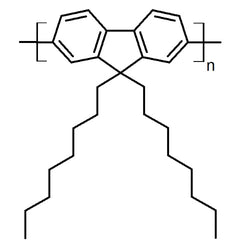
| Chemical Formula | (C29H41)n |
| Full Name | Poly(9,9-di-n-octylfluorenyl-2,7-diyl) |
| Recommended solvents | Toluene, xylene, chlorobenzene |
| Synonyms | F8 PFO |
| Classification / Family | Polyfluorenes, Benzothiodiazoles, Organic semiconducting materials, Semiconducting polymers, OLED green emitter materials, OLED materials, Organic photovoltaic (OPV) materials, Polymer solar cells, OFET materials |
For a high-efficiency green OLED we recommend blending F8 with F8BT with the below specifications. This ink can then be applied either in air, or in a glove box, with little difference in performance (provided exposure time and light levels are minimised). For more details see our fabrication guide.
At typical concentrations of 10 mg/ml, 100 mg of F8 (PFO) will make around 200 devices on Ossila's standard ITO substrates (20 x 15 mm), assuming 50% solution usage (50% loss in filtering and preparation).
OLED reference device:
F8 with F8BT
Blend ratio of 19:1 (F8:F8BT) in Toluene
Total concentration of 10 mg/ml
0.45 µm PTFE filter (hydrophobic)
Spun at 2000 rpm (approx. 70 nm thickness)
Pipetting 20 µl of the above solutions onto a substrate spinning at 2000 rpm should provide a good even coverage, with approximately 70 nm thickness. The substrate needs to be spun until dry, which is typically only a few seconds — 15 seconds should be ample to achieve this. Thermal annealing should be undertaken at 80°C for 10 minutes prior to cathode deposition.
A basic, efficient OLED can be made using PEDOT:PSS as a hole-transport layer and Calcium/Aluminum as the electron contact. When used with the Ossila ITO glass OLED substrates and shadow masks this produces an easy to fabricate yet efficient >100 cd/m2 device.

推荐产品
至尊版地址:www.zerenbio.cn
公司网址:https://www.app17.com/c153392
手机商铺:https://wap.app17.com/c153392
手机网站:m.zerenbio.cn
Dumont、Fine Science Tools、Rubis、Regine、Vetus、ideal-tek、Sipel、Weller、GilderGrids、Techni-Tool、Genesee Scientific、AIMS、Cell..

 在线咨询5分钟应答


